Dear friends,
Suddenly, we wonder how almost 20 years have passed since a small group, united by their love for rebetiko, started to give shape and substance to the idea of a musical gathering for rebetiko in Skyros. The undertaking was big and difficult because having an idea is not enough. An idea can certainly be the garment that dresses an action or an initiative, but there must also be genuine love, consistency, and devotion from those who will put their time and heart into making that idea a reality. And why Skyros? Because Skyros is not just any Aegean Island. It is an island that hovers in the cultural realm of our country, from the prehistoric era of the Pelasgians to today, honoring history and the arts, and especially music with its traditional and rebetiko roots. Roots that spread into the fertile soil of our modern Greek identity and struggle to maintain our unique cultural worth, amidst the modern whirlwind of globalization that erodes distinct cultural traditions.
We are proud because our project may have gone through difficulties and problems, but it succeeded, within the human limits we had set, in achieving our goals for rebetiko, that is, to strengthen the awareness, deeper study, and promotion of it to a wider audience, mainly young people.
Rebetiko, this popular musical idiom that emerged in Piraeus in the first half of the 20th century and, with the contribution of many musical currents, created a legacy of cultural musical value now recognized by UNESCO as an element of the Intangible Cultural Heritage of Humanity, in the tough times we are living.
This year, the international seminar-meeting in Skyros took place from July 12 to 19, 2026, on the beautiful and welcoming island of Skyros, with our steady collaborators, the local community, the Municipality of Skyros, SNΕ (Skyros Shipping Company), the Skyros Cultural Association “Anemoessa” and the Faltaits Museum.
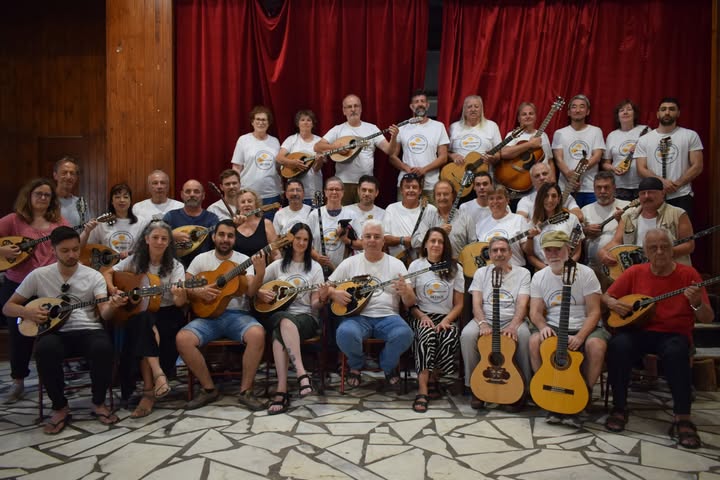
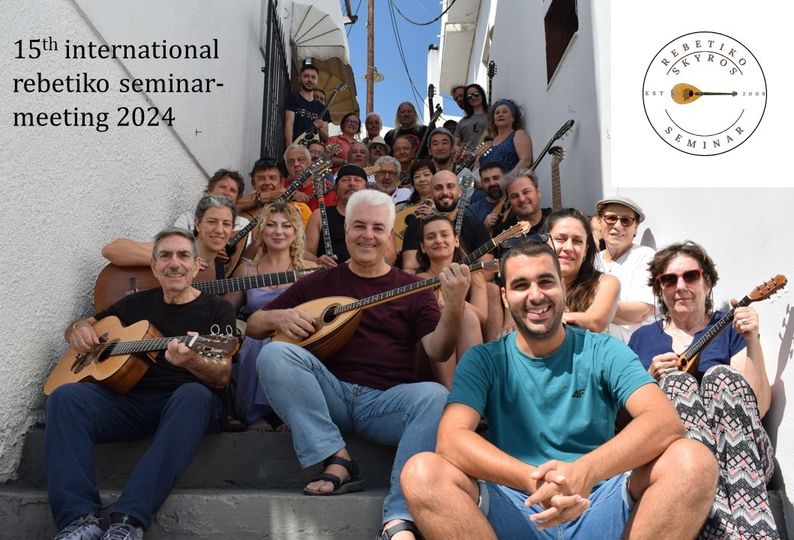
Our annual gathering with friends and musicians from Greece, Finland, France, Germany, Turkey, Slovenia, Bulgaria, Japan, Cyprus, and Canada filled us once again with joy and smiles. Guided by the authenticity, ethics, and style of our folk music, we armed ourselves with courage and hope for the difficult days ahead. We drew strength that filled our eyes and hearts with light. And this strength and light, we believe, was felt by all the visitors of the island, who joined us in our musical evening outings to the island’s picturesque taverns, where they voluntarily took part in this folk music feast, as a continuation of the daily four-hour educational process with a fun and free program.
But, the gathering of the wider audience and participants continued with two speeches given at the beautiful theater space of the Elementary School on the following topics:
14/7/2026 “From the Margins to the Stage: The Female Instrumentalist in Rebetiko” Speaker: Olga Papadopoulou, with simultaneous English translation by Kostas Kakoutopoulos. Translation – Text Editing: Olga Papadopoulou
16/7/2026 “The Birth of Rebetiko in the Greater Piraeus and Kokkinia Area” Speaker: Nikos Nikolaou, with simultaneous English translation by Maria Genitsariou. Translation – Text Editing: Maria Genitsariou
The open events concluded with the rebetiko concert open to the public, featuring a fun and danceable program in the main square of the island on 17/7/2026 and the online broadcast of the concert on 18/7/2026, which included the songs from the courses of the 17th international seminar-meeting on rebetiko https://youtu.be/52Hwd5HweOs?si=Dub-Y9La1UL_-gE9.
We are pleased to inform you that the proceedings of the 17th International Seminar-meeting on Rebetiko, which took place from July 12 to 19, 2026, have been published online. Among others, we are presenting for the first time an interview with a photo report from the Finnish participants at the 10th seminar (15-22/7/2018), Ari Turpeinen and Katri Nisula on the topic of «rebetiko». The interview had been published in the Finnish magazine «Kansanmusiikki». Finally, we present the songs, which were taught at the 17th Seminar in Greek and English, edited and translated, as always, by our friends and collaborators in the joint effort Henk Stoffels and Kostas Kakoutopoulos, whom we warmly thank. You can read the minutes and see the snapshots of the 17th seminar on rebetiko at the link below: https://www.rebetikoseminar.com/wp-content/uploads/2026/10/Praktika_17_2026.pdf
Until the next 18th international seminar-meeting, we take a little rest and prepare—not alone, but together with you—because now we are “us.” Together we will continue our musical journey, guided by our love and respect for rebetiko music, which blossomed like a little flower in the yards and small shops of Piraeus, thanks to its anonymous and well-known contributors, spreading the fragrance of hope and “protesting” against heartless behaviors, wherever they came from.
We move forward… living with music in our hearts and minds, because music unites…
Giorgos Makris and Spyros Goumas